Friday, September 28, 2012

Drawing From Memory

by Allen Say
Scholastic | 2011

This 2012 Sibert Medal Honor book chronicles Allen Say's personal journey from childhood to adult illustrator and writer. Told in the first person, the book invites the reader to journey with Say from the Japan of his childhood beginning with his birth in 1937 through his struggles with his parents around his chosen vocation to his independent living in an apartment of his own at the age of 12. It continues through his apprenticeship with one of the most lauded Japanese cartoonists to his choice to join his father in the United States.

The book is told through both words and pictures and feels a bit like a graphic novel. At 64 pages, it is picture book for slightly older readers and perfect for discussions about discovery: discovery of self, of meaning, and of family. Say's stories are gifts to children's literature (check out Grandfather's Journey and The Bicycle Man for two of my favorites) and he's known for his nonfiction stories that are largely autobiographical.

Don't miss this book. It's not only beautiful, it's also poignant in a gentle, understated way that leaves room for the reader's own interpretation. A perfect combination.

Wednesday, September 26, 2012

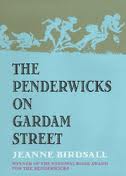
Penderwicks Series (100th post)

THIS IS THE BOOK PILE'S 100th POST. HAPPY 100 DAY!

by Jeanne Birdsall
Knopf | 2005, 2008, 2011

This absolutely charming series about the four Penderwick children and their father, dog, and others they meet through their adventures are true treats for children and parents alike. I chose the series for the 100th post of the Book Pile because of a recent conversation with a childhood friend who shared how much her own children have loved it.

Rosalind, Skye, Jane, and Batty have lost their mother and live and travel with their doting father. They each play roles in the family and are supportive of and exasperated by each other in equal measure, which makes their relationships real and relateable. In the first book they spend the summer at Arundel, an estate; in the second they are at home on Gardam Street; and in the third are on vacation once again at Point Mouette. Each setting allows for exploration and development of the characters.

Jeanne Birdsall visited one of my classes last spring and shared that she wanted to write books that reminded her of what she loved as a child. She set out to create characters and situations rooted in the realistic innocence of childhood. She's succeeded. And as the National Book Award Winner gold seal on the first volume attests, others agree.

The set would make the perfect birthday or Christmas gift for any child in your life. They are fantastic read aloud stories and wonderful books for new readers ready for longer chapter books.  Don't miss the Penderwick series!

Monday, September 24, 2012

Meet the Author: Mel Schuit

Mel with The Pigeon
Why do you write for children?
I write for children because it’s what feels natural to me. I attended the University of California, Davis to get my BA in Studio Art and spring semester of my junior year I had this crisis moment when I realized that everything I made was very one-dimensional, that all of it was just something to hang on a wall. I (very luckily) happened to begin my Intro to Children’s Literature class that semester and as I began looking at the picture books a sort of light bulb went off in my head. I decided then that I wanted my artwork to be accessible on a different kind of level, that I wanted it to be a part of something bigger. As someone who had always taken an interest in English and was pursuing an English minor at the time it was like being smacked in the face with the solution: picture books. Writing YA came a few years later and I think it stemmed from wanting to tell darker stories surrounding existentialism to people who were experiencing the same feelings as my characters. I firmly believe that children can grasp difficult concepts at an early age but writing for young adults offered me an opportunity to examine those concepts from a more mature point of view.

What's the most difficult part of crafting a story?
I think the most difficult part of crafting a story is that eventually the story is out of your hands—at some point the characters take over and it’s all you can do to keep up. No matter how intent I am on my novels or picture books going in a specific direction, the characters inevitably take hold of the story and start making their own decisions. It makes writing trickier but you learn so much more about what your characters are capable of and how they learn and grow.

How does your writing offer something new to the children’s literature world?
I’d like to think that my stories and illustrations offer something new in the sense that they become an amalgam of what I’ve admired in other stories and illustrations. I’ve spent twenty-five years reading, writing, and illustrating, but mostly I’ve spent that time absorbing and learning. My stories and illustrations are interpretations of the messages I’ve gathered from a long line of children’s literature and convey what I feel is important to creating a story for a child. So really, my offering is my experience and what I’ve learned.

Mel Schuit is currently an MA/MFA candidate in Children’s Literature/Writing for Children at Simmons College in Boston and she received her BA in Studio Art from the University of California, Davis in 2009. Although most of her free time is taken up by her chatty cat Toothless, she is also working on a picture book about a pineapple named Penelope and a young adult novel about a grim reaper. Feel free to find out more about Mel at melschuit.wordpress.com or to follow Penelope on twitter @spiky_penelope

Friday, September 21, 2012

Clothesline Clues to the Jobs People Do


by Kathryn Heling and Deborah Hembrook
illustrated by Andy Robert Davies
Charlesbridge | 2012

In this delightfully simple book, very young readers are asked to anticipate what job folks do based on the things hanging on their clotheslines. As a letter carrier makes her way from house to house delivering invitations to a party, we meet a chef, an artist, a farmer, and more. Everyone gathers at the end for a good-bye party for the launch of the final neighbor, an astronaut.

The illustrations are bright and basic to allow perfect hints so kids can successfully figure out who they'll meet next. And the text is early-reader ready. I can imagine a kindergarten lesson in which kids are asked to draw their own imaginary clotheslines with hints to their dream job for when they grow up for classmates to guess.


No matter the use, this is a wonderful curl-up-together-and-discover book!

Wednesday, September 19, 2012

The House of the Scorpion


by Nancy Farmer
Atheneum Books for Young Readers | 2002

Matt is an unusual child. He lives in a house in the woods with Celia and he never goes outside. He knows some about how the world works from watching television, but has never experienced anything himself. One day, children show up near the house and see him, banging on the door. He's afraid and enthralled. Soon, he's integrated into the bigger estate and the favored child of El Patrón, the 140-year-old lord of a country called Opium, situated between the United States and what used to be Mexico, which controls all the drug exports to the rest of the world. Matt is favored for a reason. He's the seventh clone of El Patrón, each and every one eventually killed through harvests of organs to keep El Patrón alive.

To say anymore about what happens would be the worst kind of spoiler, so I'll stop here and just say that this National Book Award Winner also won a Newbery Honor and a Printz Honor. Farmer's story-telling skill and her ability to write such a futuristic story in such modern, every-day language are both part of the draw. There's a lot to wonder about here: what makes a person a person? Why and how are decisions made and institutions built? Who has the power and how did they get it?

Matt can help you ponder some of these questions and more.


Monday, September 17, 2012

The Relatives Came


by Cynthia Rylant
illustrated by Stephen Gammell
Bradbury Press | 1985

This past summer, my relatives came. My brother donated his house, only a few miles from my parents' house, and couch surfed at friends' for a week. My sister and brother-in-law and my two nieces; a cousin and her husband and their two kids; another cousin (sister to the first cousin) and her husband and their two kids; my aunt (sister to my mother and mother to my two cousins) and another of her grandchildren who belongs to yet another cousin who couldn't make the trip himself; all came to stay. They arrived in two stuffed cars and two different airplanes. A trip to the beach involved three cars and seven car seats. My relatives came, they sure did. And we had as much of a glorious time as the folks in Cynthia Rylant's timeless book.


The anticipation of their arrival, the day they show up, and hugging are all part of relatives coming to stay. "Those relatives just passed us all aroudn their car, pulling us against their wrinkled Virginia clothes, crying sometimes. They hugged us for hours." What lovely words.

The book takes the reader through the visit--eating with so many people to feed, sleeping with a shortage of beds, celebrating together, and the poignant sadness of the leaving when "our beds...felt too big and too quiet." That dull achy feeling at the pit of a stomach after a visit--the physical manifestation of missing someone--Cynthia Rylant hits it right on the head. Gammell's illustrations are soft, rendered in what appears to be colored pencil, adding a lighthearted whimsy to the text. The road they travel is windy and hilly and the car bounces along as if alive. The joy on the faces of each and every relative can remind children that even when the house is crowded and cousin Billy just whupped you a good one, we're all still family. And that's what matters.

Friday, September 14, 2012

Graceling

by Kristin Cashore
Houghton Mifflin | 2007

I regularly bemoan the fact that I don't enjoy fantasy writing. I say bemoan because I know how much some people love it and that there are some really talented writers in this genre that I don't appreciate enough. Occasionally, a book comes along that lures me over into this genre; Graceling is one. I first read it in 2009 or so and just re-read it for class.

Katsa hails from the Middluns and she's graced. She has the mark--two different colored eyes--and her grace allows her to fight and kill with an acuity that makes her a commodity. Gracelings in the Middluns, regardless of their special skill, are feared. Katsa's uncle Randa, the King, has appropriated her life and uses her to punish citizens who have crossed him, sending her to maim, threaten, or kill them. When she winds up in the middle of a plot which involves kidnapping the father of the Queen of Lienid and rescues the old man, she meets his youngest grandson, Po, who is also graced. But Po is Lienid, and they revere their graced brethren. But alas, Po's grace is so threatening to others, he keeps it a secret from everyone but his mother and grandfather.

Even though Katsa has declared she will never marry and never bear children, she falls in love with Po as they depart Randa's court and work together to rescue Bitterblue, the Princess of Monsea and daughter of the evil King, Leck. Katsa also learns, through trusting Po like she's never dared trust another person that her grace isn't what she thought it was--it's actually far more nuanced and more powerful than she thought.

One of the most awesome parts of this book is Katsa's resolve to remain single, which Cashore shores up continually with passages like this one: "She couldn't have him, and there was no mistaking it. She could never be his wife. She could not steal herself back from Randa only to give herself away again--belong to another person, be answerable to another person, build her very being around another person. No matter how she loved him...She loved Po. She wanted Po. And she could never be anyone's but her own."And, true to her word and desire, she remains her own--managing to both love and live freely (unlike another favorite hero of mine with a name that starts with "Kat").

Graceling is the first in a trilogy, called The Graceling Realm, with the other two as companion books rather than sequels. The second book, Fire, follows another girl and shares one main character from Graceling, and the third book focuses on Bitterblue, now Queen of Monsea. All three have been met with critical acclaim (check out the NYT Review of Books from this past summer). Kristin graduated from the Simmons Center for the Study of Children's Literature where I'm a student, so perhaps you'll think me biased. You'd be wrong, though. She's not good--she's great. She writes these epic books (Graceling is 471 pages) longhand on legal pads and then edits them by hand as well. This astounds me, considering the intricate plots and details that link together to unwind into the brilliant stories.

Do you consider yourself to be uninterested in fantasy? Join the club. And then go get Graceling.