SPECIAL NOTE: Tomorrow, January 26, 2013, is my 40th birthday. This week, January 22, 2013, was the 40th anniversary of Roe v. Wade. I've always been proud to share a birth-week with such a momentous moment in women's rights history. This week also now marks the day that the armed forces allowed women into combat roles, opening the entire military up to us. In honor of these two 40th anniversaries and new moment in history, I present a book about a woman of gumption.
by Shana Corey
illustrated by Hadley Hooper
Scholastic | 2012
Buy it now! (It's cookie time, after all.)
This book is the perfect gift for anyone in your life who is currently a Daisy, Brownie, or Girl Scout or for any adult who once was one. We also just passed the 100th anniversary of the founding of the Girl Scouts, in March 2012. Every Girl Scout knows their founder's name: Juliette "Daisy" Gordon Low, but how many know about her early life and how she came to found the organization in the United States?
This charming account of a "girl with gumption" tells the story of Low's founding of the Girl Scouts (modeled on the Girl Guides of England). The art is stylized and fun--created with paint, ink, and printmaking along with some digital enhancements. The earth-toned palette is perfect for this story about early environmentalism. If I have any complaint, it's about the somewhat overwhelming design (small primary text, larger secondary text that appear to be quotes from Low and too-varied text placement end up feeling a bit haphazard).
The book includes a "gallery" of famous Girl Scouts, a lengthy author's note including information about her personal Girl Scout connection, the U.S. history era in which the organization was founded, information about conservation efforts, diversity, the Girl Scout Promise and Law, a source list, and acknowledgements.
Add this book to your Girl Scout cookie shopping list this year!
Showing posts with label early reader. Show all posts
Friday, January 25, 2013
Wednesday, January 2, 2013
Lola Reads to Leo
by Anna McQuinn
illustrated by Rosalind Beardshaw
Charlesbridge | 2012
Buy here!
Lola is a little girl who is getting a little brother or sister soon. She loves stories and reads with her mom and dad. They are preparing for the baby and when he arrives, Lola is ready to help! Leo is a great little brother who requires a lot of work, but Lola (and her parents) are up to the task.
This third installment for the "Lola books," which also includes Lola Loves Stories and Lola at the Library, is the perfect book for little kids who are expecting a sibling. Lola's family is as traditional as they come--Mommy; Daddy; a clean, safe house; and lots of love to go around.
These wholesome stories are written clearly and simply, inviting in new independent readers. "Lola's day always ends with a story. Tonight's story is about a little girl and her new baby brother."
The art is bright and fun. These books are true winners. (The first two are also available in Spanish, and the third is coming soon in that language.)
illustrated by Rosalind Beardshaw
Charlesbridge | 2012
Buy here!
Lola is a little girl who is getting a little brother or sister soon. She loves stories and reads with her mom and dad. They are preparing for the baby and when he arrives, Lola is ready to help! Leo is a great little brother who requires a lot of work, but Lola (and her parents) are up to the task.
This third installment for the "Lola books," which also includes Lola Loves Stories and Lola at the Library, is the perfect book for little kids who are expecting a sibling. Lola's family is as traditional as they come--Mommy; Daddy; a clean, safe house; and lots of love to go around.
These wholesome stories are written clearly and simply, inviting in new independent readers. "Lola's day always ends with a story. Tonight's story is about a little girl and her new baby brother."
The art is bright and fun. These books are true winners. (The first two are also available in Spanish, and the third is coming soon in that language.)
Friday, December 28, 2012
Snowflake Bentley
by Jacqueline Briggs Martin
illustrated by Mary Azarian
Houghton Mifflin | 1998
Buy it here!
This Caldecott Medal book is about William Bentley, who discovered much of what was known about snow crystals during his lifetime. Born in 1865, as a boy in Jericho, Vermont, he spent the long winters there determined to make photographs of snowflakes. After a lot of trial and error, he learned how.
Azarian's gorgeous woodcut prints, which according to the copyright page are hand-tinted with watercolor, couldn't be more perfect for the story and it's no wonder they won the Caldecott. It's clear through her artwork that Azarian is not only a Vermonter, but a snow-lover. And indeed, her dedication in the book reads: "For all the snow lovers of the world, who--like me--think that snow is like chocolate; there is never enough."
As a snow and winter lover myself, I find this is the perfect book with which to curl up next to the fire. Snuggle in with someone and read about Snowflake Bentley. This book is as unique as the snowflakes Bentley found so fascinating.
illustrated by Mary Azarian
Houghton Mifflin | 1998
Buy it here!
This Caldecott Medal book is about William Bentley, who discovered much of what was known about snow crystals during his lifetime. Born in 1865, as a boy in Jericho, Vermont, he spent the long winters there determined to make photographs of snowflakes. After a lot of trial and error, he learned how.
Azarian's gorgeous woodcut prints, which according to the copyright page are hand-tinted with watercolor, couldn't be more perfect for the story and it's no wonder they won the Caldecott. It's clear through her artwork that Azarian is not only a Vermonter, but a snow-lover. And indeed, her dedication in the book reads: "For all the snow lovers of the world, who--like me--think that snow is like chocolate; there is never enough."
As a snow and winter lover myself, I find this is the perfect book with which to curl up next to the fire. Snuggle in with someone and read about Snowflake Bentley. This book is as unique as the snowflakes Bentley found so fascinating.
![]() |
| One of W.A. Bentley's photographs. |
Friday, December 14, 2012
Mr. Willowby's Christmas Tree
![]() |
| The cover I have |
McGraw Hill | 1963 (most recent re-issue, 2000)
Order it!
"Mr. Willowby's Christmas tree came by special delivery."
And so begins my absolute, hands-down, favorite Christmas story ever. For close to forty years, my family's copy has been pulled out, displayed, and read over and over again at Christmas.
![]() |
| The 2000 cover |
Your kids will beg you to read it again and again and you just might find, after they've gone to bed and the house is quiet, that you pull it out one more time for a re-read all on your own. It's that lovely.
Wednesday, December 12, 2012
Guest Reviewer Sian Gaetano: Me and My Dragon
Written and illustrated by David Biedrzycki
Charlesbridge Publishing | 2011
Buy now!
Buy now!
“Some kids want a dog. Others would like a cat.” But Hameer
wants… “a dragon!” And Hameer is smart enough to know that getting a dragon is
just like getting any other pet: you have to choose which kind you want
carefully, bring him to the doctor for his shots, name him (Sparky!), give him
a home, feed him, and bring him for walks. And, just like any other pet, if
he’s a naughty dragon, he might have to go to obedience school. Unlike other
pets, though, Sparky can act as the campfire on camping trips, melt all the
snow in the neighbor’s driveways, and may accidentally terrorize the
kite-flying community. He’s also a great friend to have around in case of
bullies or Brussels sprouts.
I cannot begin to express how very much I love this book—the
joys are too many to count. The story is endearing, quirky, fast-paced and just
so incredibly funny. And the play of text and illustration! Biedryzycki
masterfully builds text that needs illustration and illustration that adds so many
layers to the book. Each page has tons of things to look at and enjoy from the
intraiconic text, to a mouse living in Hameer’s room, to the reactions of pets
and people near Sparky. Both Hameer and Sparky, through text and illustration,
are exciting, active, and completely round characters. And, for the love of all
things children’s book related, check out the endpapers! In general, a joy. And
a book I’ve been reading three times a day.
Siân Gaetano is, before all else, a reader. She is currently
pursuing an M.A. in Children’s Literature at Simmons College (to be
finished in Summer 2013) and working evenings serving the good people
of Boston food
and beverage. She was an editorial intern at Charlesbridge for the Fall 2012 semester.
Monday, December 10, 2012
How Do Dinosaurs Say Happy Chanukah?
by Jane Yolen
illustrated by Mark Teague
Blue Sky Press | 2012
Order it now!
Starting with How Do Dinosaurs Say Goodnight? in 2000 and continuing through this latest installment, kids and parents will enjoy these silly stories that educate. Yolen and Teague do a fantastic job of addressing all the important aspects of Chanukah while still making the story laugh-out-loud funny.
Written in crisp, concise verse, this story should become a mainstay for holiday time, regardless of which holiday you celebrate!
illustrated by Mark Teague
Blue Sky Press | 2012
Order it now!
Starting with How Do Dinosaurs Say Goodnight? in 2000 and continuing through this latest installment, kids and parents will enjoy these silly stories that educate. Yolen and Teague do a fantastic job of addressing all the important aspects of Chanukah while still making the story laugh-out-loud funny.
Written in crisp, concise verse, this story should become a mainstay for holiday time, regardless of which holiday you celebrate!
Friday, December 7, 2012
Martin & Mahalia: His Words and Her Song
by Andrea Davis Pinkney
illustrated by Brian Pinkney
Little, Brown | August 2013
pre-order now!
(reviewed from galleys)
Children's book living-legends and husband-and-wife team Andrea Davis Pinkney and Brian Pinkney come together again--this time for a glorious portrayal of Dr. Martin Luther King, Jr and Mahalia Jackson. This gorgeous and spiritually-worded book begins with separate portrayals of the two subjects and then brings them together, mirroring their relationship in real life. The water color in the illustrations lend a softness and the India ink pen highlights a strength in the images.
Some words and phrases on each page are rendered in a bigger, sans-serif font, allowing for the reader's eye to focus in on what's most important on that page. The water-color-like color of those words keeps them clearly linked to the images. The story uses a metaphor of a road map to invite the reader in before the title page and carries the story along the path towards the Civil Rights era and the path toward a greater freedom for all in the United States. Ending with the March on Washington for Jobs and Freedom, the book is appended with an author's note, an illustrator's note, a list of further reading, a discography of Jackson's work, acknowledgements, and a time line.
This is a picture book, yes. But it is a fine example of why picture books are not always for the smallest readers. While a younger child might appreciate the images and could perhaps sit through an entire reading, this is the kind of book that is meant for older readers. This book invites kids as old as high-school to sit down and dive in. The illustrations add context and a fluidity to an understanding of the impact both King and Jackson had on United States history. This book shows with words and with pictures why the struggle was difficult, yet also vibrant and joyful. And while everyone has heard of King, is everyone familiar with the role Jackson played? I would guess: probably not.
The book opens: YOU ARE HERE. . . . Take the road. Come along. With Martin and Mahalia." I echo this first page. Get this book. Take the road the Pinkneys offer.
illustrated by Brian Pinkney
Little, Brown | August 2013
pre-order now!
(reviewed from galleys)
Children's book living-legends and husband-and-wife team Andrea Davis Pinkney and Brian Pinkney come together again--this time for a glorious portrayal of Dr. Martin Luther King, Jr and Mahalia Jackson. This gorgeous and spiritually-worded book begins with separate portrayals of the two subjects and then brings them together, mirroring their relationship in real life. The water color in the illustrations lend a softness and the India ink pen highlights a strength in the images.
Some words and phrases on each page are rendered in a bigger, sans-serif font, allowing for the reader's eye to focus in on what's most important on that page. The water-color-like color of those words keeps them clearly linked to the images. The story uses a metaphor of a road map to invite the reader in before the title page and carries the story along the path towards the Civil Rights era and the path toward a greater freedom for all in the United States. Ending with the March on Washington for Jobs and Freedom, the book is appended with an author's note, an illustrator's note, a list of further reading, a discography of Jackson's work, acknowledgements, and a time line.
This is a picture book, yes. But it is a fine example of why picture books are not always for the smallest readers. While a younger child might appreciate the images and could perhaps sit through an entire reading, this is the kind of book that is meant for older readers. This book invites kids as old as high-school to sit down and dive in. The illustrations add context and a fluidity to an understanding of the impact both King and Jackson had on United States history. This book shows with words and with pictures why the struggle was difficult, yet also vibrant and joyful. And while everyone has heard of King, is everyone familiar with the role Jackson played? I would guess: probably not.
The book opens: YOU ARE HERE. . . . Take the road. Come along. With Martin and Mahalia." I echo this first page. Get this book. Take the road the Pinkneys offer.
Wednesday, November 28, 2012
Olive and the Big Secret
by Tor Freeman
Templar Books/Candlewick | 2012
Buy now!
Molly tells Olive a secret and Olive does pretty well not telling anyone until she finally cracks and shares the secret with Joe (she almost told Ziggy!). Joe tells someone and that someone tells someone and pretty soon, word gets back to Molly, who confronts Olive straightaway. It's the classic story of how secrets become not-so-secret anymore.
The mostly spot art and large type is perfect for early readers as well as for younger kids as a read aloud. Hints on the end papers and on the title page give some clues into what the big secret is all about, and work in concert with the back endpapers to confirm it. Heavy glossy paper and lots of white space add to the overall appeal of the design. Freeman's animal characters are endearing (Olive is a cat, Molly is a bunny, Joe is a turtle, and so on . . .).
This is the perfect book about an important lesson without being too heavy handed about it.
Templar Books/Candlewick | 2012
Buy now!
Molly tells Olive a secret and Olive does pretty well not telling anyone until she finally cracks and shares the secret with Joe (she almost told Ziggy!). Joe tells someone and that someone tells someone and pretty soon, word gets back to Molly, who confronts Olive straightaway. It's the classic story of how secrets become not-so-secret anymore.
The mostly spot art and large type is perfect for early readers as well as for younger kids as a read aloud. Hints on the end papers and on the title page give some clues into what the big secret is all about, and work in concert with the back endpapers to confirm it. Heavy glossy paper and lots of white space add to the overall appeal of the design. Freeman's animal characters are endearing (Olive is a cat, Molly is a bunny, Joe is a turtle, and so on . . .).
This is the perfect book about an important lesson without being too heavy handed about it.
Friday, November 23, 2012
Z is for Moose
by Kelly Bingham
illustrated by Paul O. Zelinsky
Greenwillow | 2012
Buy now!
This is one of the stand-out books of the year! (I can hardly believe I've not included it in the Book Pile until now, actually.)
Zebra is organizing all the things that represent the letters of the alphabet as they line up to appear in the book. Starting before the title page, we see Moose holding up the curtain so the reader can have a peek at everyone getting ready. On the copyright page, the stairs and doorway appear and Apple holds Ball's hand (and Ball has its teddy bear). Zebra, with his referee shirt, cap, and whistle, is ready to go.
Apple heads boldly up the stairs and sits on the stage while "A is for Apple" appears below it on the page. (Zebra peeks in to ensure everything is going smoothly.) Things progress just fine through B and C and suddenly, there is Moose, with "D is for Moose" above him, and Zebra charging in telling him, "Moose? NO. Moose does not start with D. You are on the wrong page." Moose departs, right across the gutter into Elephant, who is doing his thing over on the E page. From here, things only go down hill. And then end in a lovely friendship-filled ending just right for a picture book!
When I gave this book to my niece, she howled. She laughed. She giggled. She insisted we read it over and over and over. She brought it to school and insisted the teacher read it to the class. She howled some more. She's 4. I hope every kid who encounters this book gets as much pleasure as Sonia does from it! I think they will. (And grown-ups? You can have a chuckle too!)
illustrated by Paul O. Zelinsky
Greenwillow | 2012
Buy now!
This is one of the stand-out books of the year! (I can hardly believe I've not included it in the Book Pile until now, actually.)
Zebra is organizing all the things that represent the letters of the alphabet as they line up to appear in the book. Starting before the title page, we see Moose holding up the curtain so the reader can have a peek at everyone getting ready. On the copyright page, the stairs and doorway appear and Apple holds Ball's hand (and Ball has its teddy bear). Zebra, with his referee shirt, cap, and whistle, is ready to go.
Apple heads boldly up the stairs and sits on the stage while "A is for Apple" appears below it on the page. (Zebra peeks in to ensure everything is going smoothly.) Things progress just fine through B and C and suddenly, there is Moose, with "D is for Moose" above him, and Zebra charging in telling him, "Moose? NO. Moose does not start with D. You are on the wrong page." Moose departs, right across the gutter into Elephant, who is doing his thing over on the E page. From here, things only go down hill. And then end in a lovely friendship-filled ending just right for a picture book!
When I gave this book to my niece, she howled. She laughed. She giggled. She insisted we read it over and over and over. She brought it to school and insisted the teacher read it to the class. She howled some more. She's 4. I hope every kid who encounters this book gets as much pleasure as Sonia does from it! I think they will. (And grown-ups? You can have a chuckle too!)
Monday, November 19, 2012
Red Knit Cap Girl
by Naoko Stoop
Little, Brown | 2012
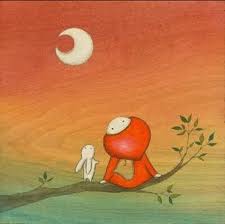
This New York Times Best Illustrated Books of 2012 winner is about a small girl who is trying to get close enough to the moon to talk with her. She and her small white bunny try everything to no avail. She asks for help from the wise owl, who isn't much help at all. Finally, she devises a plan which at first seems to fail, but then.
This charming, quiet story is a pleasure and the artwork makes it that much better. Fairly often, I need to check the copyright page to figure out how art was rendered. This time, though, I knew from the start this gorgeous art was done on plywood. The knots and contours of the wood shows through the art and onto the page, lending movement and emotion to each image. In some cases, bare wood has been left as a border, or as a part of the overall illustration. Stoop uses ink, paint, and pencil on the plywood, which lends a multi-layered feel.The matte pages add to the overall aesthetic.

Don't miss this one. Red Cap Girl and White Bunny will share their adventures with your littlest reader!
Wednesday, November 14, 2012
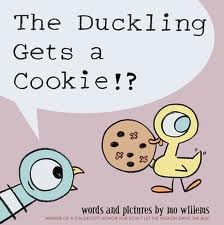
The Duckling Gets a Cookie?
by Mo Willems
Hyperion | 2012
The latest installment in Willem's pigeon book series involves a very cute little duckling, who, because he possesses some manners, gets a cookie. And of course, along comes the pigeon in all his glory and has a fit because he never gets what he asks for. What happens next is totally unexpected and kind of hilarious. You'll love it. And so will any kid reading alongside you.
The very clever end papers give a hint about the story and as usual, the story starts before the first page, in this case on the copyright page where the pigeon declares: "I do not like the look of that title." This sort of metatextual joke is one of my favorite things about picture books, which can do all kinds of fun things with art.
I think, in 2012, the pigeon is as recognizable to young Americans as Mickey Mouse is. Don't miss his latest story!
Hyperion | 2012
The latest installment in Willem's pigeon book series involves a very cute little duckling, who, because he possesses some manners, gets a cookie. And of course, along comes the pigeon in all his glory and has a fit because he never gets what he asks for. What happens next is totally unexpected and kind of hilarious. You'll love it. And so will any kid reading alongside you.
The very clever end papers give a hint about the story and as usual, the story starts before the first page, in this case on the copyright page where the pigeon declares: "I do not like the look of that title." This sort of metatextual joke is one of my favorite things about picture books, which can do all kinds of fun things with art.
I think, in 2012, the pigeon is as recognizable to young Americans as Mickey Mouse is. Don't miss his latest story!
Friday, November 9, 2012
Noah Webster & His Words
by Jeri Chase Ferris
illustrated by Vincent X. Kirsch
Houghton Mifflin | 2012
This nonfiction biography picture book about Noah Webster and the creation of the first dictionary is fantastic! Full of great facts and the story of how Webster became the father of the American dictionary, it is written clearly with excellent definitions of fourteen words built right into the story.
From the first page:
"Noah Webster always knew he was right, and he never got tired of saying so (even if sometimes, he wasn't). He was, he said, full of CON-FI-DENCE" [noun: belief that one is right] from the very beginning."
The whimsical drawings bring the story even more to life, and the prodigious use of squiggles in the art bring a "handwritten" quality to all the illustrations. One awesome detail in the illustrations stands out. On a page about how Webster sailed to Europe to use the libraries in there to finish his dictionary, the illustration is of a boat on the ocean. The ocean waves are made of words, all having to do with ships. I only know that because I looked them up! Taffrail, gaff, moonraker, stunsail, tilller, halyard, and more are spread across that ocean and it's a lovely detail!
The book includes a detailed timeline that interweaves Noah Webster's life with important American dates; after all, he was born in 1758 and died in 1843 and during his lifetime, the United States was born. He is buried in New Haven in Grove Street Cemetery next to Yale. The book also includes a longer note about Noah Webster and a bibliography that includes websites.
Biographies are not boring! And this one proves it yet again.
illustrated by Vincent X. Kirsch
Houghton Mifflin | 2012
This nonfiction biography picture book about Noah Webster and the creation of the first dictionary is fantastic! Full of great facts and the story of how Webster became the father of the American dictionary, it is written clearly with excellent definitions of fourteen words built right into the story.
From the first page:
"Noah Webster always knew he was right, and he never got tired of saying so (even if sometimes, he wasn't). He was, he said, full of CON-FI-DENCE" [noun: belief that one is right] from the very beginning."
The whimsical drawings bring the story even more to life, and the prodigious use of squiggles in the art bring a "handwritten" quality to all the illustrations. One awesome detail in the illustrations stands out. On a page about how Webster sailed to Europe to use the libraries in there to finish his dictionary, the illustration is of a boat on the ocean. The ocean waves are made of words, all having to do with ships. I only know that because I looked them up! Taffrail, gaff, moonraker, stunsail, tilller, halyard, and more are spread across that ocean and it's a lovely detail!
The book includes a detailed timeline that interweaves Noah Webster's life with important American dates; after all, he was born in 1758 and died in 1843 and during his lifetime, the United States was born. He is buried in New Haven in Grove Street Cemetery next to Yale. The book also includes a longer note about Noah Webster and a bibliography that includes websites.
Biographies are not boring! And this one proves it yet again.
Wednesday, November 7, 2012
Castle: How It Works
by David Macaulay
David Macaulay Studio/Macmillan | 2012
David Macaulay's new early reader series, My Readers, kicks off with Castle: How It Works. David is already famous for his other Castle book, written in 1977, along with his other amazing books about buildings (Mosque, Pyramid, City, and more) as well as the one that started it all in 1973, Cathedral. He is also lauded for his The Way Things Work books. You should check out all of his books, but for now let's stick with this new one in this new series.
Here, David explains how a castle works in words and pictures accessible to new readers. He writes in the second person, addressing the child reader and inviting them into the castle. He gives a a tour about how things work for both friends and foes of the castle.
Some text examples:
"If you are friend you must first climb a steep ramp. It ends at a wooden drawbridge. The drawbridge crosses the moat."
"If you are a foe, or an enemy, you won't be let in. To capture the castle you will have to surround it and wait. This is called a siege."
The clear and precise language allows early readers to investigate both words and pictures independently.
The book includes a Words to Know section complete with a diagram of the castle's parts, a list of websites to visit to learn more, and an index for the most intrepid readers. Jet Plane: How It Works is also available already, and more titles are planned.
David Macaulay Studio/Macmillan | 2012
David Macaulay's new early reader series, My Readers, kicks off with Castle: How It Works. David is already famous for his other Castle book, written in 1977, along with his other amazing books about buildings (Mosque, Pyramid, City, and more) as well as the one that started it all in 1973, Cathedral. He is also lauded for his The Way Things Work books. You should check out all of his books, but for now let's stick with this new one in this new series.
Here, David explains how a castle works in words and pictures accessible to new readers. He writes in the second person, addressing the child reader and inviting them into the castle. He gives a a tour about how things work for both friends and foes of the castle.
Some text examples:
"If you are friend you must first climb a steep ramp. It ends at a wooden drawbridge. The drawbridge crosses the moat."
"If you are a foe, or an enemy, you won't be let in. To capture the castle you will have to surround it and wait. This is called a siege."
The clear and precise language allows early readers to investigate both words and pictures independently.
The book includes a Words to Know section complete with a diagram of the castle's parts, a list of websites to visit to learn more, and an index for the most intrepid readers. Jet Plane: How It Works is also available already, and more titles are planned.
Friday, November 2, 2012
Monsoon
by Uma Krishnaswami
illustrated by Jamel Akib
Farrar, Straus, & Giroux | 2003
It is the end of the dry season in an Indian city and a young girl and her family await the monsoon rains that will wash away the dust and bring renewed life. As they go from home to market to the streets, they wish and hope that the rains will come soon and in just the right amount. Too little rain means difficulty as does too much.
Akib's soft drawings are perfect for both the mood and topic of the book. The family includes the protagonist, a young girl and her younger brother, mother, father, and grandmother. They live in a modern, upper-middle-class home and wear a mixture of Western and traditional Indian clothing. The book introduces a weather phenomenon most American children won't be familiar with and places it in a place that looks both familiar and foreign at the same time.
On the copyright page a brief, helpful glossary explains a few Hindi words not defined in the text. This is a lovely book. Don't miss it's quiet and graceful story.
illustrated by Jamel Akib
Farrar, Straus, & Giroux | 2003
It is the end of the dry season in an Indian city and a young girl and her family await the monsoon rains that will wash away the dust and bring renewed life. As they go from home to market to the streets, they wish and hope that the rains will come soon and in just the right amount. Too little rain means difficulty as does too much.
Akib's soft drawings are perfect for both the mood and topic of the book. The family includes the protagonist, a young girl and her younger brother, mother, father, and grandmother. They live in a modern, upper-middle-class home and wear a mixture of Western and traditional Indian clothing. The book introduces a weather phenomenon most American children won't be familiar with and places it in a place that looks both familiar and foreign at the same time.
On the copyright page a brief, helpful glossary explains a few Hindi words not defined in the text. This is a lovely book. Don't miss it's quiet and graceful story.
Wednesday, October 31, 2012
Trick or Treat
written and illustrated by Leo Landry
Houghton Mifflin | 2012
As Oliver Ghost makes his way around inviting his friends to his Halloween party, one invitation floats away and ends up in the hands of two children. They come to the party and have a great time, completely unaware they are partying amongst real ghosts, goblins, and witches!
Landry's simple illustrations are absolutely adorable. The Halloween story is unique and different than all the other Halloween stories out there. Get this one for your little ghosts and tricksters this year!
Houghton Mifflin | 2012
As Oliver Ghost makes his way around inviting his friends to his Halloween party, one invitation floats away and ends up in the hands of two children. They come to the party and have a great time, completely unaware they are partying amongst real ghosts, goblins, and witches!
Landry's simple illustrations are absolutely adorable. The Halloween story is unique and different than all the other Halloween stories out there. Get this one for your little ghosts and tricksters this year!
Monday, October 29, 2012
The Obstinate Pen
by Frank Dormer
Henry Holt | 2012
Uncle Flood's new pen arrives while Horace is visiting. He flees as Uncle Flood demands silence to write. He begins, "The following story is all true." But that's not what the pen writes. The pen, who is obviously obstinate, writes, "You have a BIG nose." Uncle Flood tries again. The pen insults him again. So Uncle Flood throws it out the window.
What follows is a stream of adults discovering and attempting to use the pen to no avail and with different reactions. In the end, it is Horace who winds up with the pen, and a surprise. For, it appears, in the right hands, the pen has no need to be obstinate.
This unique and original idea has turned into a fantastically illustrated picture book. It's funny and clever and droll. The characters are entertaining and readers learn quite a bit about each one, which is quite a feat considering the small number of words in a picture book.
Imagine if your pen suddenly started writing whatever it wanted rather than what you wanted. Ask your young readers to imagine it. What might it say? What a fun classroom activity!
Friday, September 28, 2012
Drawing From Memory
by Allen Say
Scholastic | 2011
This 2012 Sibert Medal Honor book chronicles Allen Say's personal journey from childhood to adult illustrator and writer. Told in the first person, the book invites the reader to journey with Say from the Japan of his childhood beginning with his birth in 1937 through his struggles with his parents around his chosen vocation to his independent living in an apartment of his own at the age of 12. It continues through his apprenticeship with one of the most lauded Japanese cartoonists to his choice to join his father in the United States.
The book is told through both words and pictures and feels a bit like a graphic novel. At 64 pages, it is picture book for slightly older readers and perfect for discussions about discovery: discovery of self, of meaning, and of family. Say's stories are gifts to children's literature (check out Grandfather's Journey and The Bicycle Man for two of my favorites) and he's known for his nonfiction stories that are largely autobiographical.
Don't miss this book. It's not only beautiful, it's also poignant in a gentle, understated way that leaves room for the reader's own interpretation. A perfect combination.
Scholastic | 2011
This 2012 Sibert Medal Honor book chronicles Allen Say's personal journey from childhood to adult illustrator and writer. Told in the first person, the book invites the reader to journey with Say from the Japan of his childhood beginning with his birth in 1937 through his struggles with his parents around his chosen vocation to his independent living in an apartment of his own at the age of 12. It continues through his apprenticeship with one of the most lauded Japanese cartoonists to his choice to join his father in the United States.
The book is told through both words and pictures and feels a bit like a graphic novel. At 64 pages, it is picture book for slightly older readers and perfect for discussions about discovery: discovery of self, of meaning, and of family. Say's stories are gifts to children's literature (check out Grandfather's Journey and The Bicycle Man for two of my favorites) and he's known for his nonfiction stories that are largely autobiographical.
Don't miss this book. It's not only beautiful, it's also poignant in a gentle, understated way that leaves room for the reader's own interpretation. A perfect combination.
Friday, September 21, 2012
Clothesline Clues to the Jobs People Do
by Kathryn Heling and Deborah Hembrook
illustrated by Andy Robert Davies
Charlesbridge | 2012
In this delightfully simple book, very young readers are asked to anticipate what job folks do based on the things hanging on their clotheslines. As a letter carrier makes her way from house to house delivering invitations to a party, we meet a chef, an artist, a farmer, and more. Everyone gathers at the end for a good-bye party for the launch of the final neighbor, an astronaut.
The illustrations are bright and basic to allow perfect hints so kids can successfully figure out who they'll meet next. And the text is early-reader ready. I can imagine a kindergarten lesson in which kids are asked to draw their own imaginary clotheslines with hints to their dream job for when they grow up for classmates to guess.

No matter the use, this is a wonderful curl-up-together-and-discover book!
Monday, September 17, 2012
The Relatives Came
by Cynthia Rylant
illustrated by Stephen Gammell
Bradbury Press | 1985
This past summer, my relatives came. My brother donated his house, only a few miles from my parents' house, and couch surfed at friends' for a week. My sister and brother-in-law and my two nieces; a cousin and her husband and their two kids; another cousin (sister to the first cousin) and her husband and their two kids; my aunt (sister to my mother and mother to my two cousins) and another of her grandchildren who belongs to yet another cousin who couldn't make the trip himself; all came to stay. They arrived in two stuffed cars and two different airplanes. A trip to the beach involved three cars and seven car seats. My relatives came, they sure did. And we had as much of a glorious time as the folks in Cynthia Rylant's timeless book.

The anticipation of their arrival, the day they show up, and hugging are all part of relatives coming to stay. "Those relatives just passed us all aroudn their car, pulling us against their wrinkled Virginia clothes, crying sometimes. They hugged us for hours." What lovely words.
The book takes the reader through the visit--eating with so many people to feed, sleeping with a shortage of beds, celebrating together, and the poignant sadness of the leaving when "our beds...felt too big and too quiet." That dull achy feeling at the pit of a stomach after a visit--the physical manifestation of missing someone--Cynthia Rylant hits it right on the head. Gammell's illustrations are soft, rendered in what appears to be colored pencil, adding a lighthearted whimsy to the text. The road they travel is windy and hilly and the car bounces along as if alive. The joy on the faces of each and every relative can remind children that even when the house is crowded and cousin Billy just whupped you a good one, we're all still family. And that's what matters.
Friday, September 7, 2012
And The Soldiers Sang
by J. Patrick Lewisillustrated by Gary Kelley
Creative Editions | 2011
This poignant picture book is about the Christmas truce on Christmas Eve 1914 on the front lines of WWI. Seen through the eyes of a fictional Welsh soldier who sings First Noel in his tenor that night, the paneled art evokes a graphic-novel or war-based comic book feel. The dark palette fits perfectly with the wartime and night-time setting and the story itself offers a look at how peace fits into history.
This one is for the older set. Use it in your 4th through 10th grade classrooms during a general war unit or on a WWI unit. Ask the students to consider how the history is woven through the story with a fictional character at the center -- does it matter if he's not actually real? Will we ever know every soldier who was there that night? Offer it to your child who is curious about war and wants to read everything s/he can get their hands on. Read it yourself. Personally, I didn't get enough WWI history in school to remember the Christmas truce all that well. But now, it'll stay with me forever.A 2012 Boston Globe-Horn Book Picture Book Honor Award winner, this one will likely be a winner in everyone's mind.
Subscribe to:
Posts (Atom)