by Cecilia Galante
Aladdin/Simon & Schuster | April 24, 2012
May, who has just completed the 8th grade, opens the story of her summer by saying "I thought it was funny. So did a lot of other kids. Miss Movado, however, did not." The reader finds out quickly that May has painted a giant avocado on the wall of her English teacher's room to poke fun at her penchant for wearing green and her round shape. As punishment, and to avoid expulsion, May will spend the entire summer re-taking the English class she barely passed and re-painting Ms. Movado's entire classroom.
May has had a tough time of it. She lives with her Gram and her father; her mother has gone. May blames herself, fights with her father, and can't get her grandmother to eat or come out of her room. She is pretty much alone except for her only friend, Olive. She keeps messing up, says she doesn't care about anything, and doesn't trust anyone. Soon, some walls start to come down and May starts to accept some help from those around her.
Told in the first person, the voice seems pretty authentic. The plot line good, but the conflict wraps up a little too easily. No matter, though - for those readers in the publisher's market for this (8-13 year olds), the twist at the end will make up for all that.
As kids finish up the school year and get ready for summer, this summer read is worth checking out!
Thursday, June 7, 2012
Wednesday, June 6, 2012
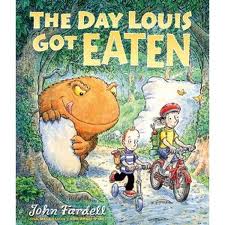
The Day Louis Got Eaten
written and illustrated by John Fardell
Andersen Press | September 12, 2011
Louis and Sarah set off from home one day, Louis on his scooter and Sarah on her bike. "[U]nfortunately, Louis was eaten up by a Gulper." A Gulper, apparently, is a giant, long tongued, fuzzy orange monster. "Sarah didn't panic. She knew that Gulpers usually swallow their food whole and that if she was quick, there might be a way to get Louis back out."
May I pause for a moment here and say I find this hilarious? I LOVE the tone of this story. It's so matter-of-fact. Sarah's little brother gets eaten by a giant woods-dwelling monster and she just goes about figuring out how to save him without even pausing for a quick "AAAAAAAUGH!" Fantastic!
Because Sarah hesitates to pick something up, the Gulper takes off and she pursues him on her bike. But, "[U]nfortuntaly, the Gulper was eaten up by a Grabular," a giant black flying monster thing. As each fanciful creature eats up each preceding fanciful creature, Sarah must get more and more clever in her chase. She must add water gear to her bike, then underwater gear, and then mountain climbing gear as she pedals along, determined to save Louis.
So much of this story is told in the illustrations. The sparse text only provides some of the information and young readers can search out the fantastic landscape drawings for other tidbits. The names of the animals provide fun, as well - Saber-toothed Yumper is my favorite.
Eventually, the intrepid Sarah manages to extract Louis from deep inside a now many-layered demise and he, comfortably curled up reading a book, says, "There you are. I knew you'd come. how are we going to get out of here?" Sarah, of course, who stopped way back at the beginning to pick something up, has just the remedy for their conundrum and saves the day. Hilariously. A quick twist at the end is a lovely tribute to the power of siblings, and Sarah and Louis head home as if nothing unusual has happened.
Fardell's artwork is pleasing, and lots of panels are used to show Sarah's progression as she chases. My favorite spread is of Sarah making her way, with the help of a flashlight, into the Saber-toothed Yumper's mouth and then into each animal to find Louis - awesome!
Andersen Press | September 12, 2011
Louis and Sarah set off from home one day, Louis on his scooter and Sarah on her bike. "[U]nfortunately, Louis was eaten up by a Gulper." A Gulper, apparently, is a giant, long tongued, fuzzy orange monster. "Sarah didn't panic. She knew that Gulpers usually swallow their food whole and that if she was quick, there might be a way to get Louis back out."
May I pause for a moment here and say I find this hilarious? I LOVE the tone of this story. It's so matter-of-fact. Sarah's little brother gets eaten by a giant woods-dwelling monster and she just goes about figuring out how to save him without even pausing for a quick "AAAAAAAUGH!" Fantastic!
Because Sarah hesitates to pick something up, the Gulper takes off and she pursues him on her bike. But, "[U]nfortuntaly, the Gulper was eaten up by a Grabular," a giant black flying monster thing. As each fanciful creature eats up each preceding fanciful creature, Sarah must get more and more clever in her chase. She must add water gear to her bike, then underwater gear, and then mountain climbing gear as she pedals along, determined to save Louis.
So much of this story is told in the illustrations. The sparse text only provides some of the information and young readers can search out the fantastic landscape drawings for other tidbits. The names of the animals provide fun, as well - Saber-toothed Yumper is my favorite.
Eventually, the intrepid Sarah manages to extract Louis from deep inside a now many-layered demise and he, comfortably curled up reading a book, says, "There you are. I knew you'd come. how are we going to get out of here?" Sarah, of course, who stopped way back at the beginning to pick something up, has just the remedy for their conundrum and saves the day. Hilariously. A quick twist at the end is a lovely tribute to the power of siblings, and Sarah and Louis head home as if nothing unusual has happened.
Fardell's artwork is pleasing, and lots of panels are used to show Sarah's progression as she chases. My favorite spread is of Sarah making her way, with the help of a flashlight, into the Saber-toothed Yumper's mouth and then into each animal to find Louis - awesome!
Tuesday, June 5, 2012
Reunited
by Hilary Weisman Graham
Simon & Schuster | June 12, 2012
Alice, Summer, and Tiernan were best friends right up until the big winter dance freshman year at Walford High School. Then something happened and it all fell apart. They've spent four years of high school on separate trajectories, with very different personalities and friends, and have been only partially cordial to each other.
But now, just after graduation, Alice learns that Level3, their favorite band when they were in middle school, is getting back together for one show in Austin, Texas. She buys three tickets on a whim, manages to convince Summer and Tiernan to join her, and all three girls pile into the Pea Pod (the 1976 green VW bus that used to be their clubhouse which Alice's parents restored as her graduation present) and hit the road from Massachusetts to Texas.
What ensues is a completely believable, very fun and sometimes frustrating journey through the trials and joys of friendship, growing up, and learning about being oneself while also trying on new ways of being. The plot twists and turns are engaging and the story progresses nicely, right up to the fantastic grand finale.
Full disclosure - I went to high school with Hilary Weisman Graham, and was friends (mostly in junior high school, funnily enough) with her sister. This fact actually worried me. Oh, no! Someone I know has written a YA novel and if it isn't good, how do I deal with that? Turns out there was no need to worry. It's great!
The jacket design follows the most recent trend with actors on the cover, and the trailer does the same. While this normally bothers me a little, Simon & Schuster cleverly use the map to block the girls' faces on the book cover, allowing the reader to imagine them for themselves. The book is aimed at readers 12 and up, and it's completely appropriate for the younger end of that spectrum while still able to maintain the interest of older YA readers - a difficult feat. Congrats, Hilary!
Simon & Schuster | June 12, 2012
Alice, Summer, and Tiernan were best friends right up until the big winter dance freshman year at Walford High School. Then something happened and it all fell apart. They've spent four years of high school on separate trajectories, with very different personalities and friends, and have been only partially cordial to each other.
But now, just after graduation, Alice learns that Level3, their favorite band when they were in middle school, is getting back together for one show in Austin, Texas. She buys three tickets on a whim, manages to convince Summer and Tiernan to join her, and all three girls pile into the Pea Pod (the 1976 green VW bus that used to be their clubhouse which Alice's parents restored as her graduation present) and hit the road from Massachusetts to Texas.
What ensues is a completely believable, very fun and sometimes frustrating journey through the trials and joys of friendship, growing up, and learning about being oneself while also trying on new ways of being. The plot twists and turns are engaging and the story progresses nicely, right up to the fantastic grand finale.
Full disclosure - I went to high school with Hilary Weisman Graham, and was friends (mostly in junior high school, funnily enough) with her sister. This fact actually worried me. Oh, no! Someone I know has written a YA novel and if it isn't good, how do I deal with that? Turns out there was no need to worry. It's great!
The jacket design follows the most recent trend with actors on the cover, and the trailer does the same. While this normally bothers me a little, Simon & Schuster cleverly use the map to block the girls' faces on the book cover, allowing the reader to imagine them for themselves. The book is aimed at readers 12 and up, and it's completely appropriate for the younger end of that spectrum while still able to maintain the interest of older YA readers - a difficult feat. Congrats, Hilary!
Monday, June 4, 2012
Meet the Author: Briana Woods-Conklin
![]() |
| Visit Briana's blog. |
Meet Briana Woods-Conklin and read an excerpt from her unpublished middle-grade manuscript Breaking All the Rules.
Why do you write for children?
I write for children because those are the books that I
loved most. My middle school reading years transformed me into a lover of
books, and while at a young age I quickly moved onto adult literature, no other
literature has impacted me in quite the same ways as the books I read during my
elementary and middle school years. Children’s books allowed me to become a
reader and lover of the written word. My heart remains with these books, and I
really hope to make another child feel that very same excitement,
identification, and desire for more literature through my own writing.
What’s the most challenging part of crafting a
story?
The
most challenging part of crafting a story is developing a sustainable conflict
that keeps readers interested and moves the plot forward. The overarching
conflict propels almost all of the character’s actions while simultaneously
drawing the reader into the story. Basic
ideas – ideas for characters, situations, moments – come easily, but developing
the idea, complicating it and drawing it out to create and carry the larger
conflict is what I find to be the hardest. Sustainable conflicts are so
essential to a good story, and while you don’t want a conflict to be too boring
or too easily solved, you likewise have to make sure that it does not fall
outside the protagonist’s real capability.
How does your writing offer something new to the
children’s literature world?
As adults,
I think the deep emotional lives of children can at times be easy to dismiss or
discount. But children do have deep emotions that are often complex,
insightful, and sincere. The everyday occurrences and problems that are
sometimes not thought of as material for a good story are most often the things
I write about. In a world that focuses
so much on the projection of images and always being ‘entertained’, as an
author, I think I try to look at the internal life of a child and give words to
emotions that might be hard to state, but easy to identify with. I think my
writing offers a look at the human condition through the eyes of a child while
still providing the reader with an interesting, and sometimes humorous, story.
Briana Woods-Conklin will receive her MFA in Writing for Children from
Simmons College in May 2013. She attended Fairfield University where she
graduated as valedictorian with a BA in English/Creative Writing in
2010. Briana works at a publishing company in Boston, MA. She currently
lives in Brookline, MA and is working on a new novel.
Sunday, June 3, 2012
Thrillers Galore!
Long Lankin by Lindsey Barraclough | July 10, 2012 | Candlewick Press
Thrillers
galore! A boy unwittingly caught up in a shadow-stealing plot, a group of teens
trying to make sense of a classmate’s disappearance, a good old-fashioned ghost
story set in present day and on the Titanic,
and kids, a cemetery, and a truly terrifying monster make up this group of
Spring 2012 releases.
The books can easily split into two groups, grouped by the quality of the writing and the stories –Ghosts of the Titanic and Long Lankin undeniably outshine The Shadow Collector’s Apprentice and The Night She Disappeared. Using believability as one barometer – after all, a good thriller thrills because, whether fantasy or realism, it seems so real, the reader could be the next victim – and literary merit as the other allows a full consideration of these texts.
Shadow attempts to tell a good story, but there are so many holes, unanswered questions, and randomly placed diary-excerpt interruptions to the third-person narrative, it doesn’t work. And while Night has a promising start, it relies on a same-old, same-old kidnapping plot with over-dramatic teenage heroism to save the day.
In contrast, Lankin and Ghosts provide tight plot lines, clear descriptions, and puzzle-piece mysteries that come together with appropriate pacing that cause the reader to gasp and exclaim with fear or delight as each discovery unfolds.
Don’t let the cheesy cover of Ghosts discourage potential middle-grade readers. Recommend Lankin to older readers, who may cower in their beds after meeting Long Lankin in the graveyard. Take a pass on Shadow and Night.
See my full reviews of Long Lankin and Ghosts of the Titanic.
The Shadow Collector’s
Apprentice by Amy Gordon | February
1, 2012 | Holiday House
The Night She Disappeared by April Henry | April
10, 2012 | Henry Holt and Company
Ghosts of the Titanic by Julie Lawson | February 1, 2012 | Holiday House
The books can easily split into two groups, grouped by the quality of the writing and the stories –Ghosts of the Titanic and Long Lankin undeniably outshine The Shadow Collector’s Apprentice and The Night She Disappeared. Using believability as one barometer – after all, a good thriller thrills because, whether fantasy or realism, it seems so real, the reader could be the next victim – and literary merit as the other allows a full consideration of these texts.
Shadow attempts to tell a good story, but there are so many holes, unanswered questions, and randomly placed diary-excerpt interruptions to the third-person narrative, it doesn’t work. And while Night has a promising start, it relies on a same-old, same-old kidnapping plot with over-dramatic teenage heroism to save the day.
In contrast, Lankin and Ghosts provide tight plot lines, clear descriptions, and puzzle-piece mysteries that come together with appropriate pacing that cause the reader to gasp and exclaim with fear or delight as each discovery unfolds.
Don’t let the cheesy cover of Ghosts discourage potential middle-grade readers. Recommend Lankin to older readers, who may cower in their beds after meeting Long Lankin in the graveyard. Take a pass on Shadow and Night.
See my full reviews of Long Lankin and Ghosts of the Titanic.
Saturday, June 2, 2012
Barnum's Bones: How Barnum Brown Discovered the Most Famous Dinosaur in the World
by Tracey Fern
illustrated by Boris Kulikov
Margaret Ferguson Books,
Farrar Straus Giroux | May 22, 2012
Well-designed
and fancifully illustrated, this picturebook biography of Barnum Brown, who had
discovered most every dinosaur bone in the American Museum of Natural History’s
collection at the time of his death in 1963, offers both information and a good narrative.
Brown, whose life details are somewhat fuzzy, was a bit of a character:
filling his childhood home with collected fossils, dubbing his intimidating
boss “My Dear Professor,” dressing formally in the field, and nicknaming his
most famous find, the Tyrannosaurus Rex, his “favorite child.”
With only this
book as reference, it could appear Brown worked largely alone, often only
accompanied by a horse and occasional by a crew who are mentioned but never
shown digging with him. Even allowing for text that seems, at times, too
amazing to be true, this quirky unknown story about a paleontologist who
learned by doing is appealing.
Double spreads with maps depicting travels and
adventures, interesting perspectives (such as of Brown, giant in the foreground
while being attacked by mosquitoes), and huge “hidden” outlines of well-known
dinosaur shapes give even the smallest readers something to search for, much
like Brown searched his entire life. Appended with brief author’s note, selected
biography, and archival photograph of Brown.
Friday, June 1, 2012
Bink & Gollie: Two for One
written by Kate DiCamillo and Alison McGhee
illustrated by Tony Fucile
Candlewick Press | June 12, 2012
Two seemingly opposite yet equally quirky friends spend the day at the state fair trying to win a giant donut, attempting to participate in an amateur talent show, and having their fortune read. Set up the same way as the first Bink & Gollie title, with three distinct stories acting as chapters, the pages vary in how much text appears – some with only a few words, some simply allowing Fucile’s comic-like art to stand for itself, and some with longer passages, which make the book a perfect beginning-reader.
Bink and Gollie seem on more equal footing here than in the first book, with Gollie looking to Bink for support after she freezes during the talent show and deferring to Bink’s determination that they’ve heard enough from Madame Prunely’s crystal ball – “That’s all the future I need to know! Come on, Gollie!”
Fucile’s use of black and white backgrounds with bright colors for people and important objects makes each page an aesthetic treat. The book’s flawless design uses heavy, glossy pages with full-bleed color for endpapers and to separate stories. Here’s hoping Two for One isn’t the last we see of these two irresistible girls.
Subscribe to:
Posts (Atom)